Get In Sync


A coach can’t order a team to move as one. But sync can be built — and it’s built one position group at a time. The detailed how, from the infield to the back four.
Tell a tense team to “calm down and lock in” and watch what happens. Usually nothing. Sometimes worse than nothing.
I’ve done it myself, early on, from the third-base box — relax, settle, breathe — and I’ve watched a whole infield nod and stay exactly as tight as it was. The words bounce off. Not because the players don’t want to settle. Because “calm down” isn’t an instruction a nervous system can follow on command, and “play as one” isn’t a switch a coach gets to flip.
So I stopped trying to order it and started trying to build it. And the thing I had backwards for years was the unit. I was coaching the team. The sync lives somewhere smaller.
You don’t sync a team. You sync its position groups — then you sync the units to each other
Here’s the moment I watch for now. Close game, late, runner on. And the infield goes quiet. Not panicked — quiet. The chatter that ran all game just stops. Each kid pulls inside his own head, and you can watch the unit come apart in real time: the shortstop and second baseman quit checking each other on the double-play depth, nobody calls the play, and the next ground ball turns into four players reacting alone instead of one group moving together. For a long time I read that silence as focus. It’s the opposite. Silence is the sound of a unit desyncing. So now I don’t shout instructions into it — I send the catcher out to walk the ball back and get them talking again. One sentence between them. The talk comes back, and the unit comes back with it.
WHAT THE SCIENCE ACTUALLY SAYS
Sync is behavioral, trainable, and tighter than people think
Moving together bonds people, chemically — a rowing crew training in sync produced a bigger endorphin surge than the same workout done alone (Cohen and colleagues, 2010). But there’s a catch the field tends to skip: the bonding shows up only when synchrony carries shared intent. Choreography for its own sake does little.
And the kind of sync that actually moves performance is behavioral, not mystical. In a 2023 study of a volleyball team, feeling synced and being physiologically synced weren’t even correlated (Tamminen and colleagues, University of Toronto). What predicts performance is players talking, moving, and acting in time — and that behavior rides on a quieter foundation: a shared mental model. When teammates share one organized picture of the job, they anticipate each other and coordinate even when there’s no time to talk (Mathieu and colleagues, 2000). Which points somewhere specific: a shared picture and tight timing are hardest to build across eleven people, and easiest across the four or five who already share a job.
THE UNLOCK
Start with the position group, not the team
The full team is the wrong unit to chase. Too big for a shared picture to stay sharp, too big for one person’s calm to reach everyone, and it rarely shares a single tightly-timed task. The position group is the opposite on every count — the infield, the battery, the double-play combo; the offensive line, the secondary; the back four, the midfield triangle; the setter and her hitters. Four reasons these are the units that actually move as one:
They share one job — a double play, a pass-block, an offside trap, a setter-hitter tempo, tightly timed and owned together. They’re small enough that contagion reaches everyone — calm and panic both travel faster across four than across eleven. They rep together constantly, which is the only soil a shared picture grows in. And their job literally is behavioral synchrony — the thing the research rewards. Sync isn’t a nice-to-have for these groups. It’s the position.
And it can be coached on purpose. In a season-long soccer case study, a staff deliberately built shared mental models into a squad — not waiting for chemistry, installing it (Gershgoren and colleagues, 2013). Here’s the build, on one card.
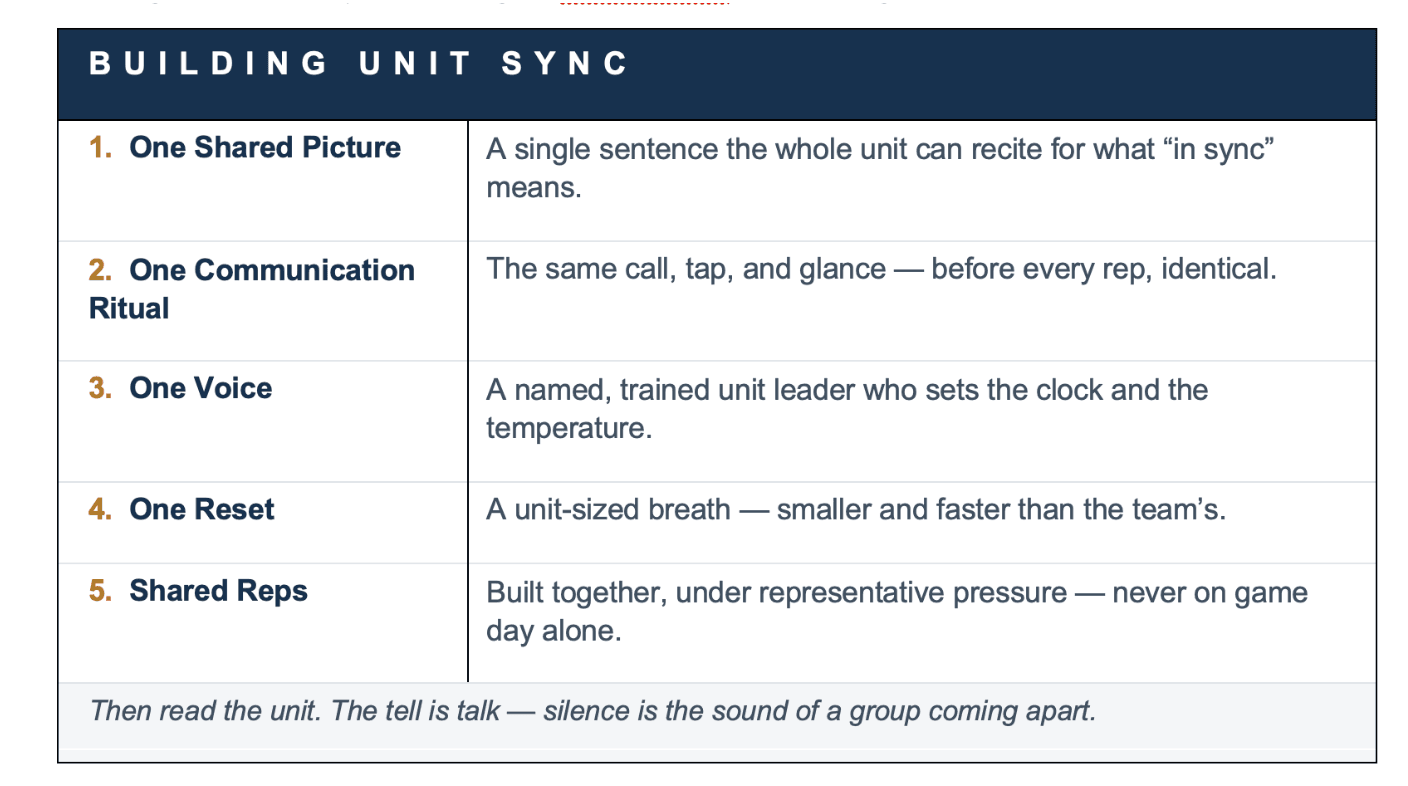
The six moves, in detail.
1. Give the unit one sentence for what “in sync” means.
That single shared definition is the mental model, made plain. Infield: we’re in sync when everyone knows the play before the pitch. Back four: we step as a line, not as four guys. O-line: we ID the front and call it as one. One sentence does more than a playbook, because it’s the picture every player checks himself against in real time, when there’s no time to ask.
2. Build the unit’s communication ritual — same every rep.
This is the behavioral synchrony you can actually drill. The call, the tap, the glance, before every play, identical — the infield’s pre-pitch cadence (outs, runners, “ball to me I go to two,” a look, a glove tap), the O-line’s line call, the back four’s “step / hold / drop.” Make it automatic and constant, because a ritual is the only kind of communication that survives speed.
3. Name the unit’s voice — and coach that player specifically.
Every group has a quarterback: the catcher, the center, the center-back, the setter, the free safety. That player sets the unit’s clock and its temperature no matter what -- whether you’ve told them to or not. So tell them, and coach them on it directly — tempo and tone, not just reads. Their job in a wobble isn’t a speech; it’s to be the steady voice and the slow body the others borrow from.
4. Install a unit reset — smaller and faster than the team breath.
A group of four or five co-regulates tighter than a group of eleven, so give the unit its own reset: the battery gathering after a walk, the O-line’s huddle-and-exhale after a sack, the back four regrouping before the restart. Same cue, same beat, every time. It’s the team breath miniaturized — and because the group is small and shares the moment, it actually lands.
5. Rep the unit together, under representative pressure.
Sync is nothing but shared reps. You build it by drilling the turn, the trap, the combo block, the setter-hitter connection — together, against live looks, not air. The double play doesn’t work because four players are calm; it works because they’ve run it until the feed, the footwork, and the release are timed to a runner they can barely see. You cannot sync a group you only assemble on game day.
6. Read the unit’s state, not just the individuals.
Coach the group as one organism, and learn its tell. For almost every unit, the tell is talk: a silent unit is a desynced unit. When the chatter dries up — the way it did in that quiet infield — that’s your cue, not to fix one player, but to reset the group. The communication isn’t a byproduct of being in sync. It’s the thing that keeps them there.
BASEBALL · THE INFIELD: The turn at second is pure synchrony — feed, footwork, release, all timed to a runner half-hidden behind the bag. It holds because the four share one picture of who covers, who’s the relay, and where the ball goes with the game on the line, repped until it’s wordless. The catcher is the voice. The dirt-drag between hitters is the reset.
SOCCER · THE BACK FOUR: A back four is in sync when it steps as a line, not four individuals — and the offside trap is the purest test there is, because one player a half-step late breaks the whole thing. You build it with one voice (the center-back), three calls obeyed without debate (step, hold, drop), and reps against a scout-team runner until the line moves like a single body.
VOLLEYBALL · THE FRONT COURT: Setter and hitters live on tempo — the “connection” is a shared clock. In sync means the hitter knows the set’s speed and spot before the ball leaves the setter’s hands, because the tempo is a shared model, not a guess. Between points the front court resets together: a word, a touch, eyes up, same place to start the next rally.
FOOTBALL · THE OFFENSIVE LINE: Five men against a moving front. In sync means they ID that front and call it as one, so a stunt meets a unit that already agreed who has whom. The center is the voice; the combo block is two men sharing one defender on a shared count; the snap cadence is the unit’s shared breath. Silence is the tell — a quiet line is a desynced line.
Then stitch the units into a team
Synced units don’t add up to a synced team on their own. The team layer is real, but it sits on top of unit sync, not instead of it.
Drill the seams between units — that’s where teams actually break. Two perfectly synced units that don’t talk to each other still lose. The breaks happen at the handoffs: infield to outfield on relays and cutoffs, back four to midfield on the press trigger, the line to the quarterback on protection IDs. Drill the seam on purpose — it’s the most-skipped and highest-leverage rep there is.
One team breath, identical every time. The whole-team version of the unit reset: a pregame ritual and one in-game reset you use on purpose — after a run scored on you, a goal conceded, a timeout. Same count, same word, rehearsed when nothing’s on the line so it survives a night when everything is.
Let your unit voices become the team’s thermostat. States are contagious — calm leaks, so does panic. The catcher, the center-back, the setter, the captain are already broadcasting. Regulate those few and the signal spreads across every unit. The body talks before the mouth does.
Give the whole team one language for states. If half your players say “I’m fine” and mean terrified, nobody can co-regulate anybody. A shared vocabulary fixes that. One example is our Weather States™ framework — a fast read where each player names today’s weather, Sunny, Cloudy, or Stormy — so a teammate can read another and reset him in a single word across a full field. It’s the difference between “something feels off” and “he’s in the storm, go settle him.”
Make warmups synchronized — and make them mean something. Don’t run unison drills as choreography. Frame them as ritual and say out loud what they’re for. It takes one sentence. Not “everybody in,” which is just a logistics call, but something like: “This isn’t a drill. This is us getting ready together — same breath, same beat.” That line is the switch.
Be an anchor yourself. A coach white-knuckling the clipboard and shouting “relax” is teaching the opposite of the lesson. Your staff’s regulation is part of the team’s — you’re the loudest thermostat in the building. Model the breath. Run the reset. Stay slow when the moment speeds up.
The honest ceiling
And here I’ll be straight, the way the field too often isn’t. The studies are real but young. Many are small and maybe not statistically significant. The line from a synced-up unit to a win on the scoreboard is still more reasonable inference than settled fact. The mechanisms — that synchrony bonds, that calm spreads, that a shared picture lets a group coordinate without talking — are well established. The payoff on the field is promising, not guaranteed. This is an edge measured in single digits. It won’t replace talent, reps, sleep, or good coaching.
But the position group is where that edge compounds, because the timing is tighter and the players depend on each other more. Frame it as a free, trainable, repeatable way to give a unit real but modest control over how it operates together — built one sentence, one ritual, one voice, one rep at a time — and they’ll keep it. The keeping is the whole point.
So the next time you watch a double play turned clean under pressure, or a back four step as one and catch a striker offside, don’t call it chemistry and leave it there. It’s a shared picture, a single voice, and a thousand quiet reps. Which means it’s something you can build — starting Tuesday, starting with one group.
Your turn, coaches: What’s the first sign you see that a unit has come apart — and what brings it back? I’d like to hear what you watch for.
Scott Wilder is the founder of Game Ready Mindset™, a mental performance platform built for high school and college athletic programs. He has spent fifteen years in and around competitive sport as a coach, scout, and mental skills practitioner — working with baseball and soccer athletes from youth development through the college level. His work focuses on the practical gap between knowing mental performance concepts and owning them under pressure. He has certifications from Brian Cain's MPM program, the National Federation of High School Mental Performance program, and Georgetown Leadership & Coaching Institute. He holds an MBA from NYU, an MA in International Conflict Resolution from the Johns Hopkins University and a Master's Degrees in Psychology from ITP. You can learn more at gamereadymindset.com, or reach me directly at [email protected]. I love talking about this work
RESEARCH SOURCES
Mathieu, J. E., Heffner, T. S., Goodwin, G. F., Salas, E., & Cannon-Bowers, J. A. (2000). The influence of shared mental models on team process and performance. Journal of Applied Psychology, 85(2), 273–283.
Gershgoren, L., Filho, E. M., Tenenbaum, G., & Schinke, R. J. (2013). Coaching shared mental models in soccer: A longitudinal case study. Journal of Clinical Sport Psychology, 7(4), 293–312.
Tamminen, K. A., Danyluck, C., Bonk, D., & Chen, R. (2023). Syncing to perform? Journal of Sports Sciences, 41(11), 1033–1046.
Cohen, E. E. A., Ejsmond-Frey, R., Knight, N., & Dunbar, R. I. M. (2010). Rowers’ high. Biology Letters, 6(1), 106–108.
Tarr, B., Launay, J., Cohen, E., & Dunbar, R. (2015). Synchrony and exertion during dance independently raise pain threshold and encourage social bonding. Biology Letters, 11(10), 20150767.